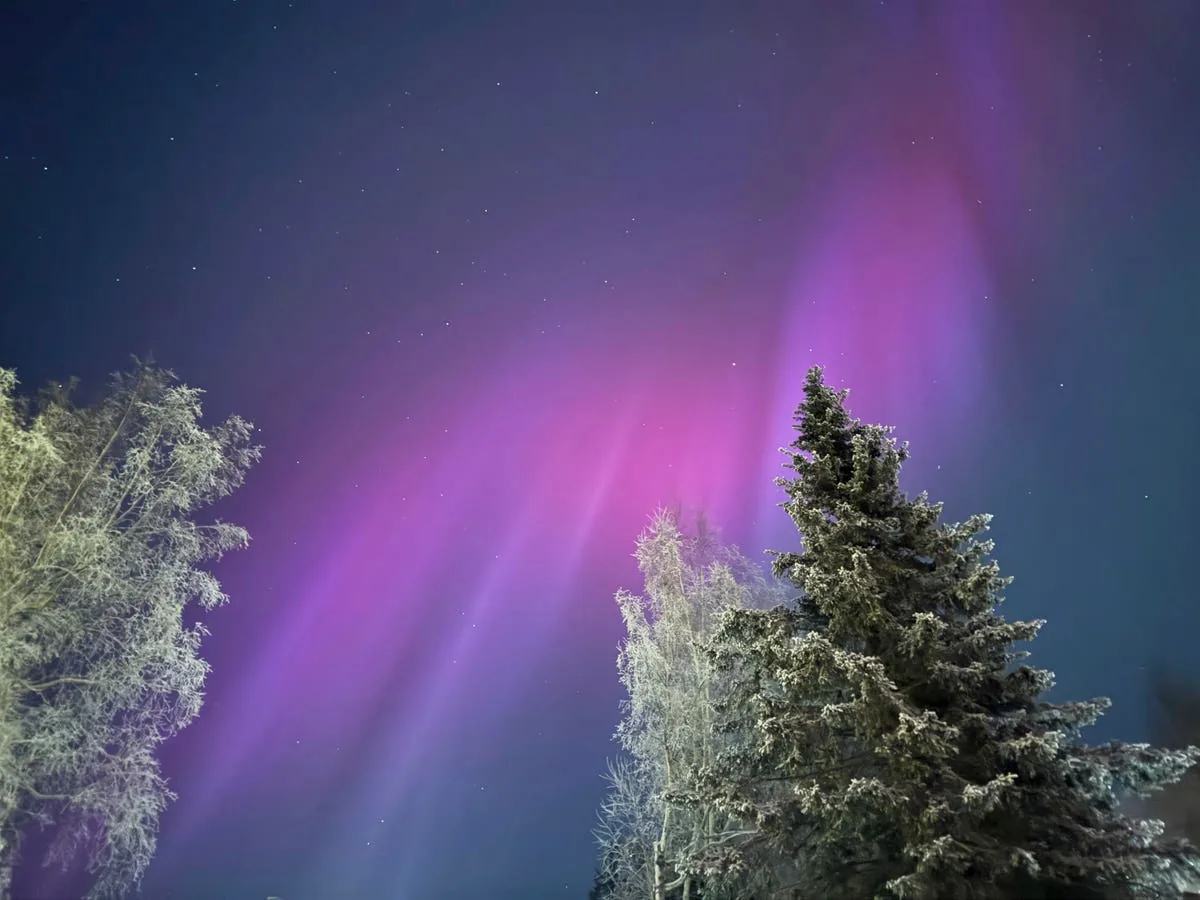
WASHINGTON, DC — The northern lights could be visible in parts of the northern United States Thursday, according to a forecast from the National Oceanic and Atmospheric Administration. NOAA is calling for a Kp index of four out of nine, a level that can make the aurora appear brighter and show more motion and structure.
The agency’s outlook is more cautious than dramatic. Its three-day forecast does not show the kind of space weather disturbances that often help push the lights farther south than usual, so the chances are concentrated near the northern edge of the country.
Where The Aurora May Appear
NOAA’s map places the lowest-likelihood viewing zone along parts of the U.S.-Canada border, including sections of Washington, Idaho, Montana, North Dakota, South Dakota, Minnesota, Wisconsin and Michigan’s Upper Peninsula. Most of mainland Alaska is also inside a high-likelihood area, although summer daylight there may make the aurora hard to see.
The forecast does not guarantee a show in any one place. It instead suggests where conditions are most favorable if skies are dark and clear enough to reveal the lights.
How Forecasters Read It
NOAA uses the Kp scale to describe geomagnetic activity, and a reading of four generally points to visible auroral structure without signaling an extreme event. In this forecast, that means the northern lights may look more active than they do during quieter periods, but not necessarily far-reaching.
That matters because the strongest auroras often arrive with space weather events that NOAA says are not currently expected. In other words, the forecast supports a modest Northern Lights watch for the border states, not a broad national one.
How To Check And Photograph
NOAA advises people to head as far north as practical, find a location with a clear view of the sky, and stay away from city lights and other sources of light pollution. The agency also says the aurora is often most active between 10 p.m. and 2 a.m., which can help narrow the window for watching.
For photos, an expert quoted by National Geographic said smartphones can do the job if they are steadied with a tripod and remote timer, set to night mode, and used without flash. If available, RAW format can also help preserve detail. Readers can verify the latest outlook through NOAA’s aurora forecast maps and space weather updates.
Wild places, night skies and what science just found, on Timberwolf Times.